
Modern Business Central E-Commerce for Agribusiness, Building Supply, Distributors, Food Service, Hardware, Landscape, Retailers, Supply Houses, Wholesalers and More
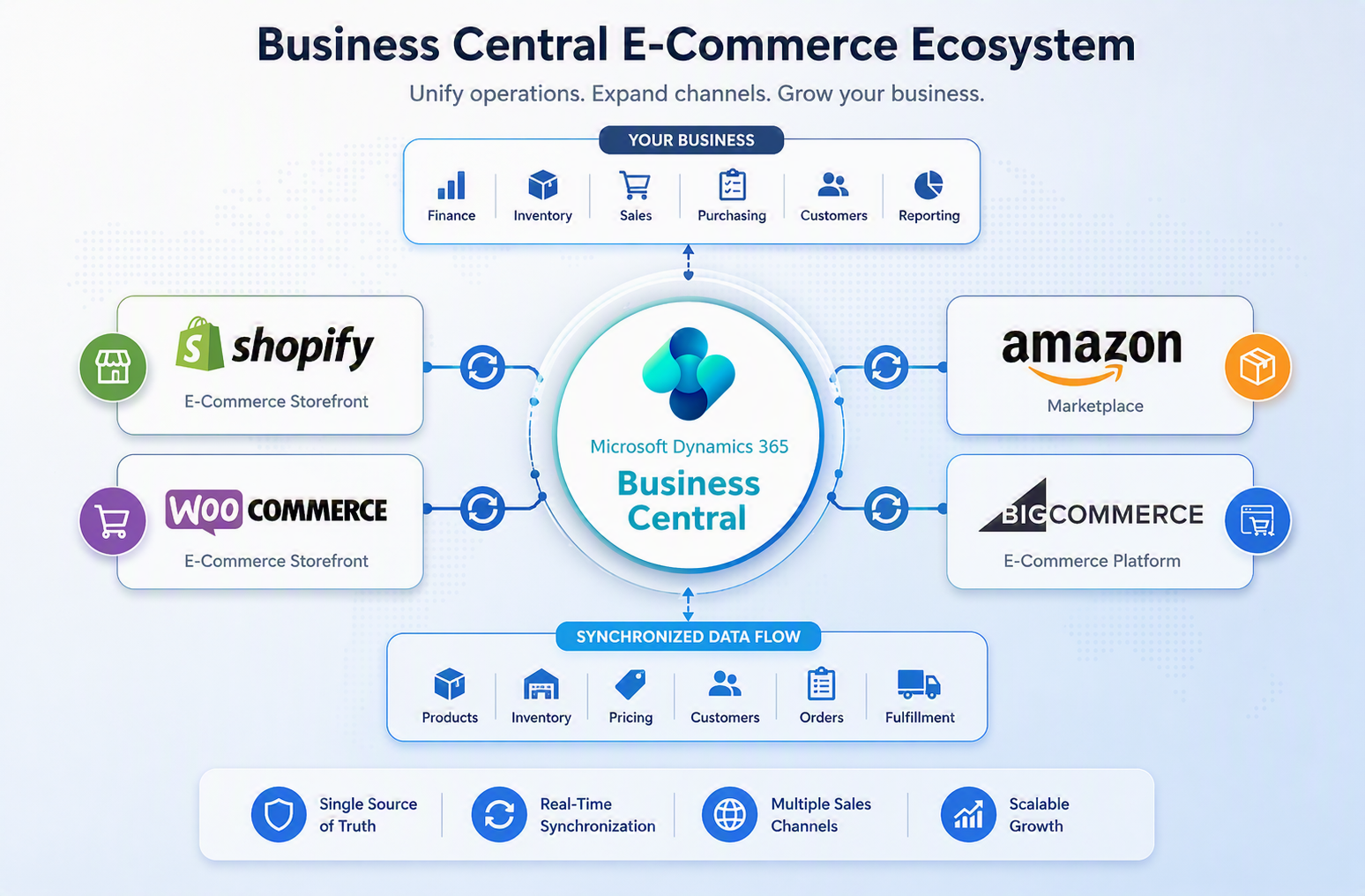
Deploy a high-performance Shopify storefront powered by Microsoft Dynamics 365 Business Central. Maintain full control of your product data, pricing, SEO, customer accounts, and online growth strategy.
Centralized Product Data
Manage SKUs, units of measure, descriptions, pricing, attributes, and product availability from Business Central.
Multi-Location Inventory
Expose accurate inventory across stores, yards, warehouses, and branches for online ordering and pickup.
B2B Contractor Pricing
Support contractor accounts, negotiated pricing, customer-specific catalogs, and account-based ordering.
Order Automation
Move web orders into Business Central for fulfillment, invoicing, inventory updates, and accounting.
Supported shopping carts for Business Central E-Commerce and Marketplace Platforms
Business Central can support a modern e-commerce strategy centered around Shopify, while also connecting through extensions and integration platforms to other online shopping carts and marketplace channels.
Shopify Platform Advantages for Business Central E-Commerce for wholesale, retail and distribution
A mainstream Business Central e-commerce platform gives independent dealers more control over SEO, customer experience, marketing, and long-term digital ownership than a storefront tied only to a POS vendor or distributor catalog.
SEO Authority
Control product pages, collection pages, URLs, metadata, and content structure.
Mobile UX
Give contractors and homeowners a fast, mobile-friendly ordering experience.
Fast Checkout
Reduce friction for cash customers buying tools, supplies, parts, and seasonal items.
B2B Ordering
Support contractor accounts, repeat purchasing, job-based ordering, and negotiated pricing.
Marketing Integration
Connect email campaigns, paid ads, remarketing, analytics, and conversion tracking.
Flexible Catalogs
Organize products by department, job type, trade, brand, season, or customer segment.
Dealer-Owned Data
Protect your customer relationships, online content, and product information.
Scalable Architecture
Continue growing even if you change POS systems, distributors, or sales channels.
Before vs. After: With Business Central E-Commerce Architecture That Protects Your Business
Many Agribusiness, Building Supply, Distributors, Food Service, Hardware, Landscape, Retailers, Supply Houses, Wholesalers and More start with an e-commerce site that is tightly tied to a POS vendor or distributor platform. Their distributor sells them the web site hosting. They mistakenly believe it is lower cost, and it's not. That can work in the short term, but it can create long-term risk if the dealer changes POS / ERP systems, changes distributors, or wants stronger SEO and marketing control. Business Central with Shopify creates a more stable, dealer-owned architecture.
POS-Dependent or Distributor-Controlled E-Commerce
The website depends heavily on the POS vendor or supplier platform.
Common Problems
- Website may need to be rebuilt if the dealer changes POS systems.
- SEO authority may be tied to a platform the dealer does not fully control.
- Product content, URLs, collections, and merchandising may be difficult to preserve.
- Marketing flexibility can be limited by the POS or distributor e-commerce model.
- Dealer may depend on a vendor roadmap instead of a mainstream E-Commerce ecosystem.
Business Central Independent E-Commerce Stack
Business Central becomes the operational system of record while Shopify powers the customer-facing storefront.
Strategic Advantages
- Dealer owns the storefront, product pages, SEO strategy, and customer experience.
- Business Central remains the stable operational backbone for inventory and financial control.
- Shopify provides a mainstream Business Central e-commerce platform with strong UX, checkout, apps, analytics, and marketing tools.
- The website can remain intact even when back-office systems or distributors change.
- B2B contractor accounts and cash customer sales can operate from the same modern commerce foundation.
The Key Difference
A POS-dependent site makes e-commerce for the store an extension of one vendor relationship. A Business Central + Shopify architecture makes e-commerce a dealer-owned business asset that can outlast POS changes, distributor changes, and technology shifts.
Sample E-Commerce Store References
These examples show how different product categories can be presented online with strong merchandising, navigation, product photography, and direct-to-consumer purchasing experiences.
Greenworks Tools
Battery-powered outdoor equipment with strong category navigation and product presentation.
View Store →STIHL Canada
Power equipment storefront showing branded tools, accessories, and outdoor equipment.
View Store →Barbo Machinery
Machinery and tool-focused e-commerce presentation for equipment-oriented buyers.
View Store →Bill’s Outdoor Supply
Outdoor, farm, and equipment products presented for practical rural and trade customers.
View Store →Lumber Shack
Wood and lumber products presented with product detail, visual merchandising, and online purchasing.
View Store →Casson Hardware
Independent hardware store example with an online storefront for hardware and related products.
View Store →Carhartt
Workwear reference for apparel, safety clothing, jobsite gear, and durable product merchandising.
View Store →Gymshark
Sporting goods and performance apparel reference for high-conversion product presentation.
View Store →What Business Central Can Do With Shopify
Business Central gives retail, wholesale and distirbution a stable back-office foundation for online ordering, while Shopify provides the customer-facing storefront experience.
Product & Catalog Sync
Publish product information from Business Central to Shopify, including SKUs, item descriptions, variants, barcodes, and category-ready item data.
Inventory Availability
Expose inventory from Business Central to the storefront so buyers can see availability before placing orders for pickup, delivery, or fulfillment.
Customer-Specific Pricing
Support the needs of contractors, tradespeople, and commercial accounts with account-based pricing and B2B purchasing workflows.
Online Order Import
Bring Shopify orders into Business Central so your team can process sales, allocate inventory, fulfill orders, and post invoices from the ERP.
Branch and Yard Fulfillment
Support multi-location operations where inventory, pickup, and fulfillment may vary by store, branch, warehouse, or lumber yard.
Accounting and Reconciliation
Keep e-commerce activity connected to financial posting.
Dealer-Owned Loyalty Programs for Business Central and Shopify
Modern e-commerce is not only about products and orders. Customer retention, rewards programs, contractor incentives, and repeat purchasing are critical to long-term growth. Business Central and Shopify allow dealers to implement a dealer-owned loyalty strategy that can evolve as business requirements, distributors, and back-office systems change.
Turnkey Loyalty Solution with LoyaltyLion
For dealers looking for a proven loyalty platform, Shopify supports integrations such as LoyaltyLion .
LoyaltyLion can provide a turnkey loyalty and rewards platform that works alongside Shopify while Business Central remains the system of record for customers, orders, products, and financial transactions.
- Points-based rewards programs
- VIP customer tiers
- Contractor and commercial account incentives
- Referral programs
- Customer retention campaigns
- Dealer-owned loyalty strategy independent of POS vendors
Business Central + In-Store + E-Commerce Loyalty
A modern architecture allows dealers to support both in-store and online customer engagement programs while maintaining a single customer view across sales channels.
Rather than tying customer loyalty exclusively to a POS vendor, distributor platform, or proprietary ecosystem, dealers can adopt a loyalty strategy that supports future business flexibility.
- Consistent customer experience across channels
- Supports contractor, retail, and commercial customers
- Dealer ownership of customer relationships
- Independent from distributor changes
- Independent from future POS replacement projects
- Stronger long-term protection of customer engagement data
Why Dealer Ownership Matters
Many distributor-hosted loyalty programs and proprietary POS loyalty programs are tightly coupled to the platform that provides them. While these programs can be useful, they may create dependencies that reduce flexibility if the dealer changes software platforms, distributors, or long-term business strategy.
- Reward history may not be easily portable.
- Customer engagement data may remain inside a proprietary platform.
- Program rules and reward structures may be controlled by a third party.
- Changing POS systems or distributors can require a loyalty program restart.
- Customers may lose accumulated rewards or loyalty continuity.
- Years of customer participation and purchasing behavior may become difficult to preserve.
Important Strategic Consideration
A loyalty program should be treated as a business asset, not merely a software feature. Dealers that rely on proprietary distributor loyalty programs or proprietary POS loyalty programs may find that future platform changes can impact customer data, reward histories, program continuity, customer engagement, and ultimately sales performance. A dealer-owned commerce strategy built around Business Central, Shopify, and leading loyalty technologies helps reduce that risk while protecting long-term customer relationships.
Why Independent Dealers Move to a Dealer-Owned E-Commerce for their business Strategy
“We wanted an e-commerce for hardware store strategy that was not dependent on one POS vendor or distributor website. Business Central gives us a stronger foundation for long-term control.”
“The biggest benefit is giving contractors a better online experience while still keeping pricing, inventory, and fulfillment connected to the back office.”
“We do not want to rebuild our website every time our systems change. A mainstream e-commerce platform protects our SEO and customer-facing brand.”
Business Central E-Commerce vs Legacy POS and Distributor-Hosted E-Commerce
The most important question is not just whether a POS system can publish items online. The bigger issue is whether the dealer owns the website, SEO authority, product content, customer data, and long-term digital strategy.
Business Central + Shopify
- Dealer retains control of website, product content, SEO, and customer experience.
- Shopify provides a mainstream storefront with strong UX, checkout, apps, and marketing tools.
- Business Central remains the operational system for inventory, pricing, orders, accounting, and fulfillment.
- The e-commerce site can remain stable even if the retail or wholesale dealer changes POS systems, distributors, or fulfillment strategy.
Paladin E-Commerce
- May be suitable for dealers that want a POS-connected online catalog.
- SEO flexibility, merchandising control, and long-term portability may be more limited than a mainstream platform.
- If the dealer later changes POS systems, the online store strategy may need to be revisited.
Epicor Eagle / Epicor Retail
- Can support e-commerce for retail / wholesale store strategies connected to the Epicor ecosystem.
- May be appropriate for existing Epicor users that want alignment with their current back-office system.
- Dealers should evaluate SEO control, ownership of product content, and portability before committing.
Rundoo
- E-commerce is not clearly documented.
- The existence of E-commerce and connection should be questioned.
- Not clearly documented, but dealers should confirm how product data, SEO pages, and online customer accounts are handled if systems change later.
ECI RockSolid / ECI Spruce
- May appeal to dealers already operating inside the ECI environment.
- Dealer should compare storefront flexibility, SEO control, and integration options against Shopify and Business Central.
- Important to confirm how online data and customer-facing content can be preserved if the dealer changes systems.
Distributor-Hosted E-Commerce
- Distributor platforms such as Orgill, Do it Best, and ACE can provide catalog-driven online selling options.
- These platforms may be useful for distributor-aligned purchasing, but can create dependency on the supplier’s catalog, platform, and branding model.
- If the dealer changes distributors, the website, item data, SEO value, and customer experience may be harder to preserve.
Take Control of Your E-Commerce Strategy
Stop treating e-commerce as an add-on to a POS system. Build a dealer-owned platform that protects your SEO, customer data, product content, and long-term flexibility.
Talk to an Expert