
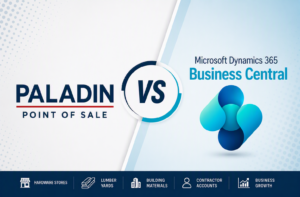
Paladin POS vs Business Central from Microsoft for Hardware Stores
Compare Paladin POS vs Business Central for independent hardware stores, lumberyards, home centers, feed and farm stores, and building material dealers that need more than simple checkout.
Paladin is well known as a hardware and lumber point-of-sale system with practical LBM features. Business Central takes a different approach: it starts as a full ERP platform with accounting, inventory, purchasing, receivables, payables, reporting, Microsoft 365 integration, and extensibility.
The real question is not just: Which system rings up sales?
The better question is: Which system can run the entire business?
Quick Navigation
Is Business Central a Paladin POS Alternative?
Yes — Microsoft Dynamics 365 Business Central can be evaluated as a Paladin POS alternative for hardware, lumber, and building supply dealers that want a broader business management platform. Because of economies of scale and Business Centrals 50,000 + users worldwide, it may even cost less.
Paladin is a POS-first system focused on independent retailers, including pharmacy, hardware and lumber businesses. It offers simple, practical store-level tools for checkout, inventory, purchasing, customer pricing, delivery, job accounts, and lumber-specific calculations. For many independent stores, that POS-first approach can be a good fit.
Business Central is different because it starts with the whole business: financials, inventory, purchasing, sales orders, customer accounts, vendor management, bank reconciliation, reporting, dimensions, multi-location structure, Microsoft Excel, Power BI, Teams, and extensible workflows. For dealers that have outgrown a store-level POS system, that broader ERP foundation can matter.
Evaluating additional hardware-store platforms? See our Rundoo POS vs Business Central comparison .
For a broader overview of the category, see our full hardware store POS comparison guide.
Paladin POS vs Business Central: Hardware Store POS Comparison
Paladin deserves a fair comparison because it is not a generic retail POS. Over the years, it has added hardware and lumber features that many small independent dealers care about. The key difference is that Business Central is an ERP-centered platform that connects POS activity to the broader financial and operational system, required to run the entire business.
| Business Requirement | Paladin POS | Microsoft Dynamics 365 Business Central | Dealer Question to Ask |
|---|---|---|---|
| Front-counter POS |
POS focused Paladin is built around point of sale for independent retailers, including hardware and lumber dealers. |
ERP-connected POS POS is connected to customers, items, inventory, pricing, receivables, purchasing, and financials. |
Do you need a POS system first, or a POS connected to a full ERP system? |
| Accounting |
Verify depth Paladin includes store business functions, but dealers should verify whether accounting is native, integrated, exported, or handled separately in their exact setup. |
Native ERP financials General ledger, receivables, payables, bank reconciliation, financial reporting, dimensions, and auditability are core Business Central concepts. |
Is accounting fully integrated, or are staff still transferring data to another system? |
| Inventory control |
Inventory-centered POS Paladin emphasizes inventory management, reorder support, margin tools, and store-level operational control. |
Inventory tied to ERP Inventory connects to purchasing, sales, costing, item ledger entries, locations, financial posting, replenishment planning, and reporting. |
Does inventory tie cleanly to purchasing, costing, accounting, and reporting? |
| Purchase orders |
Hardware ordering focus Paladin supports ordering workflows and promotes automated inventory chores and distributor connectivity. |
ERP purchasing workflow Purchase orders, receipts, vendor invoices, costs, approvals, and vendor history are part of the same ERP workflow. |
Can buyers see vendor costs, open POs, warehouse availability, receiving history, and financial impact? |
| Supplier EDI and distributor data |
Publicly promoted Paladin publicly promotes integrated EDI with national and regional distributors. Dealers should confirm the exact suppliers, files, transactions, and cost-update behavior they need. |
Supplier-specific ERP design Business Central can be extended for supplier-specific workflows such as Orgill, Do it Best, ACE, or any supplier for item files, invoices, cost updates, pricing, and purchasing, without relying on supplier or 3rd parties for ERP functions. |
Which supplier files are supported today — catalog, price, invoice, PO, EDI, POS data, and warehouse availability? |
| Contractor accounts |
Job account tools Paladin promotes job account management and customer pricing for contractor relationships. |
True A/R foundation Customer accounts, authorized buyers, credit limits, sales orders, invoices, statements, aging, and payments can live inside the same financial system. |
Are contractor accounts only POS accounts, or are they true receivables and credit-management workflows? |
| Special orders and yard orders |
LBM-specific features Paladin promotes special orders and yard orders, including hiding confidential contractor prices while still giving yard staff loading details. |
Quote-to-cash workflow Quotes, sales orders, purchasing, receiving, invoicing, job tracking, delivery, and customer history can be connected across the ERP. |
Can the system follow the full quote-to-order-to-purchase-to-receive-to-invoice lifecycle? |
| Lumber and LBM calculations |
Paladin-specific strength Paladin promotes board-foot, square-foot, thousand-board-foot, thousand-square-foot, tons, multiples, mill-unit pricing, and tally calculator features. |
Configurable ERP structure Business Central can model any units of measure with unlimited definitions, item variants, dimensions, pricing, costing, purchase units, sales units, which can handle any workflows, for any item type handled by a manufacturer, distributor or retailer. |
Do you need built-in lumber calculators, or a configurable ERP data model for broader operations? |
| Delivery |
Mobile2Deliver Paladin promotes a delivery app with adjustable time windows, delivery sorting, and completed-delivery photos, without a true cloud first software platform. |
ERP-connected fulfillment Delivery can be connected to POS sales, sales orders, shipments, inventory, customer history, billing, and route workflows. |
Do you need a delivery app only, or delivery connected to ERP orders, inventory, billing, and reporting? |
| Reporting and data access |
Review carefully Public reviews praise reports but also include complaints about report configurability, data mining, report documentation, screen sorting, and having to request special reports. |
Microsoft reporting ecosystem Business Central data can be used with built-in reporting, Excel, Power BI, account schedules, analysis views, dimensions, and extensions, and connections are live, send out, send back in. |
Can you get the reports you need without manual exports, daily workarounds, or custom report requests? |
| Data ownership and scalability |
Ask direct questions Paladin may work well for many stores, but growth-oriented dealers should ask how easily data can be accessed, exported, integrated, reported on, and used across systems. |
ERP platform model Business Central is designed as a business platform, not only a register system, making it better suited for broader workflows, integrations, analytics, and multi-location growth. |
Will the platform still fit if you add locations, ecommerce, supplier integrations, BI, or automation? |
| AI / Copilot / Microsoft ecosystem |
Not clearly documented Paladin’s public hardware and lumber positioning does not clearly document deep Microsoft Copilot, Teams, Excel, Power BI, or Dynamics 365 ecosystem alignment. |
Microsoft ecosystem Business Central is part of the Microsoft Dynamics 365 ecosystem and aligns naturally with Microsoft 365, Excel, Teams, Power BI, automation, and emerging Copilot capabilities. |
How important is Microsoft 365, Power BI, Excel, Teams, automation, and AI alignment to your future strategy? |
For a deeper look at AI and automation across systems, see our Business Central vs Epicor AI comparison.
Paladin Is POS-Centric. Business Central Is ERP-Centric.
Paladin’s strength is that it speaks the language of independent retail, hardware, and lumber operations. It gives dealers a POS-focused system with inventory features, ordering tools, contractor pricing, yard workflows, and practical front-counter usability, making it easy to move from cash register to point of sale software.
Business Central starts from a broader place. It is designed around accounting, inventory, purchasing, sales orders, payables, receivables, reporting, bank reconciliation, approvals, dimensions, audit trails, and integrations. POS becomes one part of the broader business platform.
POS-Centric View
Start at the Register
A POS-centric system usually starts with checkout, item lookup, customer pricing, inventory, sale transactions, and store operations. That can be very effective when the main requirement is running the front counter and maintaining store inventory.
ERP-Centric View
Start with the Whole Business
An ERP-centric system starts with the financial and operational structure of the company: customers, vendors, items, locations, warehouses, purchasing, sales, inventory valuation, G/L posting, margins, taxes, reporting, and management visibility.
Supplier Data: Orgill, Do it Best, ACE, EDI, Invoices, Price Updates & Item Files
Supplier data is where hardware POS systems either become extremely valuable or extremely frustrating. Dealers depend on item catalogs, UPCs, vendor SKUs, purchase orders, invoices, cost updates, warehouse availability, price changes, and accurate item relationships.
Orgill Workflows
Orgill-related workflows may include item catalog data, vendor item numbers, UPCs, price updates, invoice-driven cost updates, packaging, purchasing, and warehouse availability.
Do it Best Workflows
Do it Best dealers should review catalog updates, price updates, invoices, POS data, ecommerce, rewards, BOPIS, and supplier-specific requirements.
Multi-Supplier Item Control
Many hardware and building supply stores buy the same or similar products from multiple vendors. The system should support UPCs, vendor item numbers, alternate suppliers, costs, lead times, and purchasing logic without creating messy duplicate item records.
Contractor Accounts, Charge Sales, A/R & Job Workflows
Hardware stores and building material dealers often serve professional customers who do not simply walk in, pay cash, and leave. Contractors may buy on account, send authorized buyers, purchase for specific jobs, need negotiated pricing, require purchase order numbers, request invoices by email, and expect monthly statements.
What Dealers Need
- Charge accounts and house accounts
- Authorized buyers and account-level controls
- Job or project references on invoices
- Customer-specific pricing and discounts
- Purchase order number capture
- Statements, aging, payments, and credit management
- Historical invoices by customer and job
Why Business Central Fits This Conversation
Business Central treats customers, invoices, receivables, payments, aging, statements, credit limits, sales orders, and financial reporting as native ERP workflows.
That means contractor account management can be part of the same system used for accounting, inventory, purchasing, bank reconciliation, reporting, and management visibility — not just a counter-level charge account function.
Units of Measure: Each, Foot, Case, Board Foot, Square Foot, Ton & More
Paladin has added important lumber-specific functionality that should be acknowledged. Its public lumber materials highlight board-foot and square-foot calculations, mill-unit to customer-each pricing, thousand-board-foot, thousand-square-foot, tons, multiples, and tally calculations.
Business Central takes a broader ERP approach. It supports unlimited item units of measure, purchase units, sales units, costing, locations, variants, pricing, dimensions, and extensibility because it is prepared to manage a distributors business, or retail. For a dealer with complex LBM requirements, the best fit depends on whether the main need is built-in lumber POS calculators or a configurable ERP model that connects lumber data to accounting and operations, it's depth allows any product calculations.
| Example | Common Challenge | Paladin Angle | Business Central Angle |
|---|---|---|---|
| Lumber sold by board foot | Sales unit, stocking unit, cost unit, and price unit may not be the same. | Paladin promotes board-foot, square-foot, and thousand-unit calculators. | Business Central can model units, costing, pricing, and item relationships inside the ERP. |
| Mill unit to customer each | Vendor pricing may not match the way customers buy material. | Paladin promotes conversion from mill-unit pricing to customer-each pricing. | Business Central can be configured around purchase units, sales units, item pricing, and extensions. |
| Pipe, chain, wire, rope, and rolled goods | The same item may be bought one way and sold by length, weight, roll, spool, or package. | Paladin promotes tally calculations and lineal adjustments for lumber or rolled products. | Business Central can support unlimited units of measure and operational rules, from the manufacturer, through distribution, and retail. |
| Kits, bundles, and add-on products | Large products often have related accessories, fasteners, or job-specific add-ons. | Paladin promotes construction bundles and kits for grouped products. | Business Central supports assemblies, kits, BOM structures, GL dimensions, and custom sales workflows. |
Review Pain Categories to Evaluate Before Choosing Paladin POS
Paladin receives many positive comments for customer support, ease of use, inventory, and hardware-store fit. However, public reviews also show recurring pain categories that dealers should evaluate carefully. These are not universal complaints, but they are useful buying questions.
⚠️ Rental Department Fit
One reviewer complained that they were led to believe the system could handle a rental department, but later found it did not meet that need. If rentals matter to your store, validate the workflow before signing.
Business Central angle: Rental, service, job, or equipment workflows are native and adjustable through ERP configuration or 4000+ downloadable integrations, rather than relying on a fixed POS workflow.
⚠️ Added Costs and Hardware Expectations
A reviewer complained about added monthly costs and buying equipment they later felt was unnecessary. Dealers should clarify software fees, hardware requirements, payment devices, installation charges, support policies, and cancellation billing.
Business Central angle: A project-based ERP implementation should document hardware, licenses, extensions, services, assumptions, and responsibilities upfront.
⚠️ Reporting Flexibility and Data Mining
Some reviewers praised reports, while others wished reports were more configurable, wanted better data mining, or found report screens insufficiently documented.
Business Central angle: Business Central can support reporting through built-in pages, Excel, Power BI, financial reports, dimensions, analysis views, and custom extensions.
⚠️ Quoting and Line Editing Limitations
A building materials reviewer said quoting features made system and complained about not being able to insert an item after realizing a mistake or needing to group a product with a related item or customer note.
Business Central angle: Quotes, sales orders, lines, comments, dimensions, item substitutions, assemblies, and custom fields can be designed around the dealer’s workflow.
⚠️ Server Down, Slowness, Crashes, and Extra Clicks
Some reviews mention server-down situations, waiting during outages, crashes, slowness, multiple clicks or keystrokes, and customer frustration. These should be investigated in the context of the dealer’s deployment, hardware, network, and support model.
Business Central angle: Cloud ERP, support process, local hardware, payment devices, and offline/contingency procedures should be reviewed as part of the full operating model.
⚠️ Inventory Accuracy Concerns
Some reviews praise inventory control, while at least one negative review complained that inventory was always off. Inventory accuracy depends heavily on setup, receiving discipline, counts, units of measure, item maintenance, and process training.
Business Central angle: Inventory can be tied directly to item ledger entries, receiving, sales, adjustments, costing, valuation, locations, bins, and financial posting, that keeps all cause and effect data visible, at all times.
⚠️ Checkout Friction: Coupons, Credit Cards, Gift Cards
Some reviewers mentioned coupon designation slowing checkout, bumpy credit card or gift card transactions, or too many steps at the till. Dealers should test real checkout scenarios before deciding.
Business Central angle: POS should be tested with actual tender types, discounts, tax rules, returns, account sales, and payment processor requirements, all of which are native to ERP.
⚠️ “Bells and Whistles” for Larger Operators
One reviewer said Paladin did not have all the bells and whistles of more expensive systems. That may be acceptable for a smaller store, but larger or growing dealers should evaluate scalability.
Business Central angle: Business Central is better positioned when the dealer needs broader ERP, workflows, integrations, analytics, multi-location control, and long-term platform flexibility.
When Business Central May Be a Better Fit Than Paladin POS
Business Central May Be a Strong Fit If You Want:
- One system for accounting, inventory, purchasing, receivables, payables, and POS
- Better visibility between front-counter activity and financial reporting
- Microsoft 365, Excel, Teams, Power BI, and Copilot alignment
- Flexible integrations with suppliers, ecommerce, processors, banks, and reporting tools
- Multi-location scalability and stronger operational controls
- More control over business data, reporting, and workflows
- A long-term ERP platform rather than only a store POS system
Paladin May Still Be a Fit If You Want:
- A simple POS system, focused on independent retail
- Standard hardware and lumber POS workflows
- Added LBM (BF to EA to LF) calculators and yard-order concepts
- U.S. based POS support messaging as a key buying factor
- A system designed for smaller independent operators
- Monthly agreements and a POS vendor relationship
- Less ERP complexity if your operation does not require it
Areas That Are Not Always Clearly Documented in Public POS Comparisons
When evaluating Business Central as a Paladin POS alternative, dealers should avoid relying only on generic feature lists. The operational details matter more than the checkbox.
Supplier Integration Depth
Public materials may mention EDI or distributor integrations, but dealers should verify exactly which suppliers, files, transactions, item fields, invoices, and cost workflows are supported.
Accounting Integration
Ask whether accounting is native, integrated, exported, summarized, or handled in a separate system. This matters for A/R, A/P, sales tax, inventory valuation, bank reconciliation, and financial reporting.
Report Flexibility
Confirm whether users can build reports across POS, inventory, purchasing, customer accounts, margins, vendors, and financials without manual exports or special report requests.
Data Ownership and Access
Dealers should ask how easily they can access, export, report on, integrate, and analyze their own data.
Complex Units of Measure
Basic unit support is not the same as real hardware and LBM workflows involving each, foot, case, weight, length, board foot, square foot, ton, bundle, and vendor packaging.
AI and Automation Roadmap
Public hardware POS comparisons often do not clearly document how each system fits into Microsoft 365, Copilot, workflow automation, Power BI, Teams, or future AI-enabled business processes, and the results are in; it matters.
Questions to Ask Before Replacing Paladin POS
- Which Paladin workflows are working well today?
- Which processes still require spreadsheets, duplicate entry, manual exports, or workarounds?
- Is accounting fully integrated, or are you still relying on another accounting system?
- Can staff trust inventory quantities, costs, margins, and item history?
- Can the system manage contractor accounts, jobs, authorized buyers, PO numbers, credit limits, and statements?
- Can supplier invoice files update actual cost?
- Can price changes be reviewed before they are applied?
- Can the system support Orgill, Do it Best, Ace, Emery Jensen, House-Hasson, or your specific distributor workflow?
- Can buyers see open POs, vendor costs, warehouse availability, and receiving history?
- Can the system handle each, foot, case, board foot, square foot, ton, kit, bundle, and other hardware/LBM units?
- Can you report across stores, departments, customers, products, margins, inventory, purchasing, and financials?
- Can you connect ecommerce, payment processing, bank feeds, supplier EDI, Power BI, and future integrations?
- Does the platform fit your Microsoft 365, Excel, Power BI, Teams, and AI strategy?
You can also review our hardware store POS features checklist for a broader evaluation framework.
Continue Comparing Hardware Store POS Systems
Hardware Store POS Comparison
Compare Business Central, Epicor, Paladin, Spruce, Square, Shopify, Clover, Lightspeed, and other POS options for hardware stores and building supply dealers.
Rundoo POS vs Business Central
Evaluating additional hardware-store platforms? See our Rundoo POS vs Business Central comparison.
Evaluating additional hardware-store platforms? See our Rundoo POS vs Business Central comparison .
Orgill POS Integration
Review POS, inventory, purchasing, pricing, item files, warehouse availability, and supplier data workflows for Orgill dealers.
Do it Best POS Integration
Review catalog, price update, invoice, ecommerce, rewards, BOPIS, and supplier-specific questions for Do it Best dealers.
Paladin POS vs Business Central FAQ
Is Microsoft Dynamics 365 Business Central a POS system?
Business Central is an ERP system, not a standalone POS system. With the embedded POS the checkout is connected with accounting, inventory, purchasing, customer accounts, reporting, and management visibility.
Is Business Central a Paladin POS alternative?
Yes, Business Central can be evaluated as a Paladin POS alternative when a hardware, lumber, or building supply dealer wants a broader ERP platform. The comparison depends on POS needs, supplier integrations, accounting requirements, reporting expectations, data access, and implementation scope.
What does Paladin do well for lumber and building material dealers?
Paladin publicly promotes LBM-focused tools such as board-foot and square-foot calculators, mill-unit to customer-each pricing, yard orders, job account management, customer pricing, construction bundles and kits, delivery tools, margin tools, returns, and tally calculations.
Why would a dealer outgrow Paladin POS?
A dealer might evaluate alternatives if it needs stronger accounting integration, deeper reporting, better data access, broader ERP workflows, multi-location scalability, Microsoft ecosystem alignment, supplier-specific integrations, ecommerce integration, or fewer workarounds outside the POS.
Does Business Central support Orgill or Do it Best dealers?
Business Central supports supplier-driven hardware operations, for any supplier, because it has deep ERP Item level fields that could actually run the suppliers business. Specific Orgill or Do it Best workflows should be reviewed carefully, including item files, invoices, price updates, warehouse availability, ecommerce, rewards, BOPIS, and POS data requirements.
What should I compare before switching to a Paladin POS alternative?
Compare checkout, inventory, purchasing, supplier integration, contractor accounts, job accounts, special orders, units of measure, lumber calculations, delivery, reporting, accounting, payment processing, ecommerce, data access, support model, and long-term platform direction.
Compare Paladin POS vs Business Central for Your Hardware Store
If you are thinking about Paladin POS vs Business Central today, we can help you evaluate your current workflows against Microsoft Dynamics 365 Business Central, POS, supplier integrations, purchasing, inventory, accounting, reporting, contractor accounts, delivery, and long-term scalability.
Tip: Bring real examples — supplier price updates, special orders, contractor accounts, lumber units of measure, monthly statements, and reports you cannot easily get today.
External reference: View Microsoft Dynamics 365 Business Central